
Telemetry verification you can read, run, and sign.
Steriod turns written requirements into Axiom rule programs — plain-text artefacts an engineer can review and an auditor can sign, executed continuously against live or recorded telemetry.
- AI drafts the rules from your specification — humans approve every one
- One rule layer for V&V, anomaly detection, root-cause and trend analysis
- Runs against your existing ground segment: YAMCS, MQTT, Kafka, files
suite is $"EPS Power Health"

expect signal battery_voltage as float

rule $"battery voltage in range" is
    expect battery_voltage >= 12.0
       and battery_voltage <= 16.8

rule $"low soc triggers low power" is
    when battery_soc < 20
then eps_mode = 2 within 5 secondsSpacecraft generate telemetry faster than teams can specify, verify, and act on it.
Requirements live in PDFs. Checks live in one-off Python scripts. Anomalies are chased by hand through raw logs. And none of it is something an external auditor can read and sign.
One-off scripts everywhere
Every verification task gets its own Python or MATLAB script — unreviewed, unreusable, and unowned six months later.
Specifications drift from reality
Requirements sit in Word and Excel with no automated path from a written clause to a running check against real telemetry.
Investigations take hours
When telemetry misbehaves, engineers grep logs and reconstruct timelines by hand. Scarce expertise, slow turnaround.
Auditors can't read the code
Certification needs artefacts a reviewer can read and sign. Custom scripts and opaque ML models don't qualify.
From written requirement to running verification — one pipeline.
The order matters: nothing executes before a human has approved it. Approval is a human-only gate — no agent in the system can sign off a requirement.
Specification
A requirement document, an ECSS clause, or a pattern observed in telemetry.
AI draft
An agent reads the spec and drafts Axiom rules, explaining each one in plain English.
Human approval
An engineer edits and approves. The .axiom file becomes a signed, versioned artefact.
Execution
The Axiom engine runs the rules against live streams or recorded runs — same engine everywhere.
Evidence
Pass/fail timelines, anomaly flags, and an audit trail your V&V process can cite.
One rule layer. Five ways to use it.
Every capability below runs on the same rules, the same data, and the same engine — adopting one makes the next one cheaper.
Automated requirement V&V
Continuous verification against recorded or live telemetry, with per-rule pass / fail / pending / not-exercised status — so you also see what your tests never touched.
Live anomaly detection
Rule violations surface in real time on streaming telemetry — one vetted rule set instead of scattered alarm thresholds.
Root-cause analysis
An event timeline across signals and rules, multi-run comparison, and AI explanations grounded in your own specification documents.
Trend & data analysis
Ask questions in plain language; get a reviewable analysis plan, deterministic execution over the trend store, and a grounded summary.
Document intelligence
Import specification PDFs into a searchable knowledge base; measure requirement coverage and draft rules for the gaps.
Onboard & embedded
The same rules, compiled for the embedded C runtime — verification logic that can eventually fly with the spacecraft.
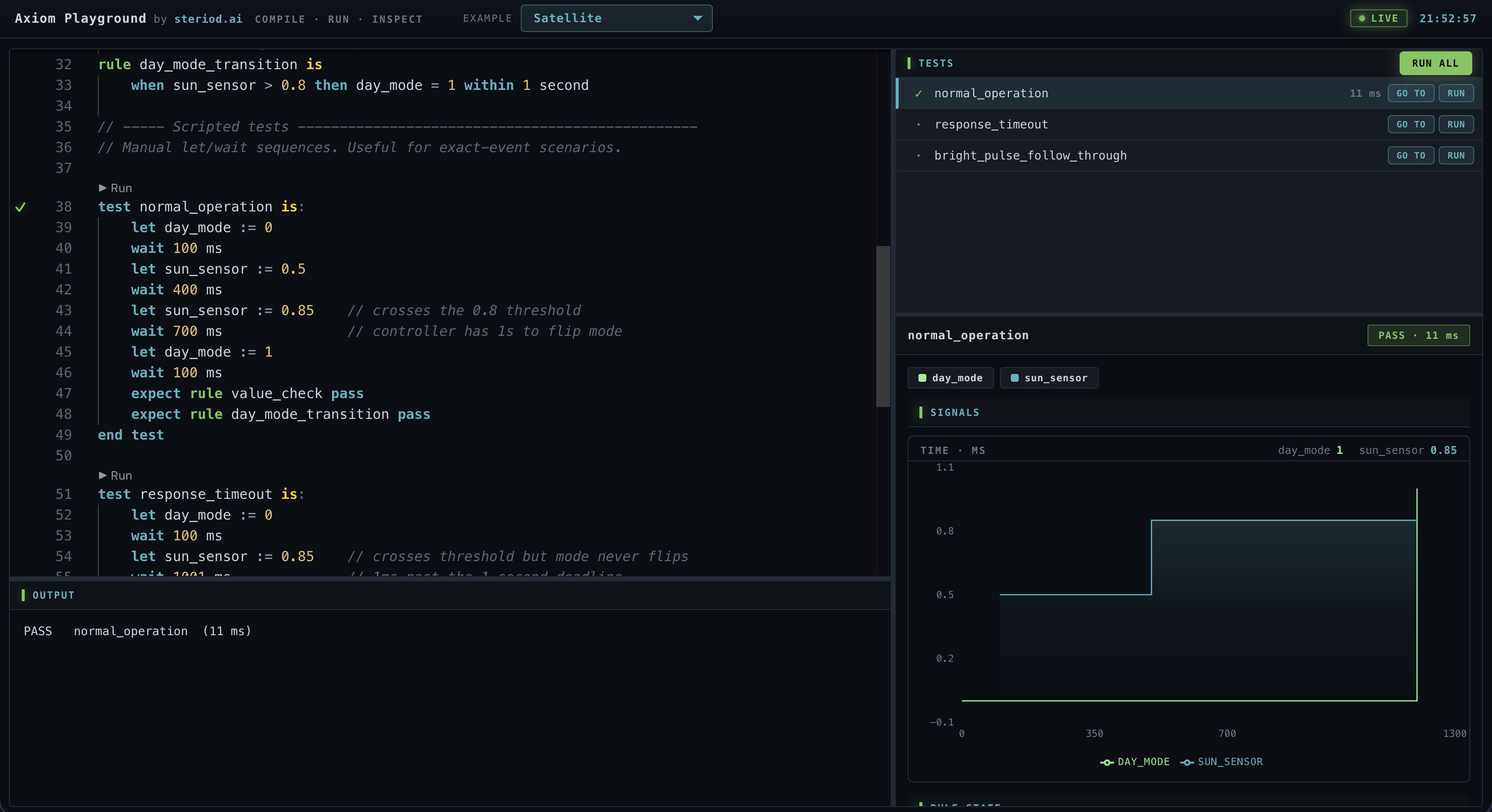
The Axiom Playground — write, run, and inspect rules in your browser.
The compiler and runtime run entirely in WebAssembly: no install, no account, no server round-trip. Write a suite, script a test scenario, and watch the signal timelines and verdicts side by side.
A platform, not a script folder.
Steriod is built from focused components around one core: the Axiom language and its runtimes. Use the desktop app, the server deployment, or both.
Axiom
A domain-specific language for temporal rules over data streams — with a compiler, a Go runtime, an embedded C runtime, and editor tooling.
Steriod platform
Desktop app and server backend sharing one service layer: projects, test suites, requirements, runs, dashboards, and a TimescaleDB trend store.
Ground-segment native
Speaks YAMCS, MQTT, Kafka-compatible streams, CCSDS packets, and XTCE signal definitions. A satellite simulator is included for end-to-end testing.
Pilot, partnership, or just curious — we'd like to hear from you.
We work directly with early teams. A short call is usually the fastest way to see whether Steriod fits your mission.